Gillian Monks

'Making Fairytales Come True'

Tag: Easter

Not My Bunny!

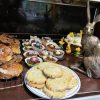
Although we have hares at Cae Non, none would agree to pose for me, so here is a model, along with some of my Easter baking yesterday.

What on earth has a rabbit got to do with Easter – or springtime? The answer is absolutely nothing! It is not a rabbit which is associated with Easter but the magical, sacred Hare – which is physically quite distinctive from its similar-looking but much smaller cousin. Unlike the rabbit, the Hare has a long tradition of featuring in various spiritual belief systems all around the world and throughout history, and is not merely a pretty character enacting a game just for children.

In many ancient cultures the Hare was regarded as a mystical animal linked to the Moon. As the cycles of the Moon rule the Earth’s waters, and also influence the female reproductive cycle, so the Hare became an archetypal symbol of the divine feminine, fertility, longevity, rebirth and the lunar cycle from new to full and waning to dark; from conception to gestation, from growth to decline and death.

Until relatively recently, the Hare was thought to be androgynous and laid its young in eggs. (See where this is leading?) Hare was thought to be representative of the way the Moon was perceived – in some cultures the waxing Moon has a masculine aspect and the waning Moon a feminine aspect. Even today, hares remind us of these ancient ways; they embody the natural rhythms – the very spirit – of life and such concepts as spiritual fulfilment and enlightenment.

The Hare is also often seen as a messenger of the Great Goddess, moving by moonlight between the human world and the realm of deity. In some traditions, the Hare is a god or goddess in his/her own right. Others demonstrate a belief that the Hare was somehow disgraced or denigrated, either out of jealousy or as a result of its own bad behaviour. There is always a very paradoxical element to the Hare, simultaneously seen as a symbol of cleverness and foolishness, courage and cowardice, rampant sexuality and virginal purity, femininity and androgyny, a sacred world creator and wily deceiver all rolled into one. Perhaps this element to the Hare’s sacred character only goes to reflect the generally amoral and untameable character of the elemental natural world.

If you would like to learn much more about the history of the Hare – and other traditions associated with Easter and this beautiful time of year, start off by dipping into my book, ‘Spring in Your Step’.

But whatever else you do this Eastertide, look at the ‘Bunny’ traditions in a new light. Here we have the sacred Hare, sowing the winter landscape with new life in the form of eggs – in themselves a symbol of new life and regeneration.

When I was a child, in the egg hunts around our garden, I was always directed to look for my chocolate treats wherever there was a flower in bloom – a natural assumption as spring flowers demonstrate the turning of the seasons and the return of light, warmth and light to the land, brought by the magical Hare.

So pay attention to the flowers… and perhaps look beneath their petals or leaves to find your own magic!

A very happy Easter to you all!

Happy Easter!

Joyous greetings!

Easter is a good time to celebrate renewal. The egg has long been a symbol of rebirth and new beginnings… it signifies potential for the coming new seasons. This year, especially, when we are all finding life more challenging, difficult, problematical or just plain heavy, Easter provides a golden opportunity to mark the ending of the old order and a fresh start – literally a brave new world.

And don’t forget the Easter Bunny, who isn’t really a rabbit at all but originally a depiction of the magical hare, recognised the world over as the incarnate connection between humanity and the natural world, the quirky, tricksy, endearing messenger between the moon and the earth, the link between our ordinary everyday life and our spiritual existence, planting the seeds of new life (eggs) around our gardens and green spaces as the natural world bursts into buds and blossoms.

Whatever your religion or spiritual beliefs, cherish and enjoy this very special and sacred time.

From my home to yours, great good wishes for a very happy day!


Nearly There!

Our Mountain

My home mountain

This evening, I am celebrating. I have just finished writing the penultimate chapter of my latest book, ‘Spring In Your Step’! I have to say that I am quite glad to be done with Easter now, although I thoroughly enjoyed writing about it… all the beliefs, traditions and lovely foods which surround its celebration!

Finally I can move on to the end of April – and the end of the book – although I am already having ideas about my next venture which might be plunging into summer… or I might take a break and focus on something quite different… we shall have to see!

But for now, I am one happy little bunny!!!

Add A Little Sweetness…

Luscious golden globes of infinite tangy sweetness!

Ah… back to more normal reality! Seeing both my books published and republished and celebrating that fact has been immensely exciting, but now it is time to turn my attention back to the more usual seasonal tasks for this time in October – and also some domestic activities which should have been seen to much earlier in the year!

For instance, the candying of peel. I usually complete this in the summer when we are enjoying lots of relaxed breakfasts with the doors and windows all thrown wide to the soft mountain breezes or sat in the sunshine in the garden. Then there are copious quantities of grapefruit  and orange peels left over. Rather than simply consigning them to the compost bin, it is far better to preserve them for use later in the autumn and winter.

This is really simple – even though it takes several days to complete. It is a process of boiling the peels in an increasingly sweetened sugar syrup and leaving them to marinade in it for days in between. (For anyone wishing to try this for themselves the recipe is included in ‘Merry Midwinter’.) I can really recommend it!

The crucial point comes at the end of the procedure when the peels are lifted out of their syrupy bath and left to drain on a wire cooling rack and then placed in the bottom oven of the Aga for several hours. The trick is to allow them to dry and set in a gentle heat for just the right amount of time so that they are dry and handleable but still soft and moist. The length of time to achieve this varies from batch to batch, depending on the size of fruit and exactly how hot my ‘cool oven’ is at the time, and no two batches of peel are ever the same.

I did actually candy a batch of grapefruit several weeks ago, but it was right in the middle of the time we were getting ‘The Alternative Advent Calendar’ ready to go to print… and I forget them. Rather than the two or three hours in the coolest part of the oven, I only remembered them twenty-fours after first placing them there to dry out. When I ran to retrieve them, they were a deep brown in colour – otherwise known as burnt – and so rock hard they could have shod a horse! Sadly not one of my finest moments!!! But sometimes these things happen. You either laugh or cry and it is by far better to laugh about it.

I prefer to candy grapefruit peel – which produces lusciously thick sticky slices of decadence – and which adds real luxury and fresh, fruity zest to home made Christmas cakes and puddings. This year I have also candied orange peels too. they give very distinct flavours and both can be sliced and dipped in melted dark chocolate for the ultimate experience with freshly brewed coffee at the end of your Christmas dinner.

Why not try it for yourself? It is really easy to do. One of these days I might even try candying whole small fruits, like clementines, which were my mother’s favourite and which always used to arrive packed in wooden boxes from Fortnum and Mason. I can strongly recommend it. You end up with a far superior product full of gorgeous sweet tangyness rather than the drier, more tasteless bought version.

Oh, and if you have any left over, it is absolutely delicious baked into Hot Cross Buns for Easter. Candied peel made this way will easily keep in an airtight container for at least twelve months.

Be adventurous! Have a go – and make something which will really set your Christmas baking apart this year.

Contact Us | Privacy Policy & GDPR |

Copyright © 2018 Gillian Monks.

Powered by WordPress & Theme by Anders Norén